
AI-powered budgeting and credit apps can simplify money management, but they’re only as helpful as the habits you build around them.
Convenience comes with tradeoffs, especially around data privacy, accuracy, and over-reliance on automation.
If you want real progress (not just insights), pairing these tools with trusted guidance like free financial counselingfree financial counseling can help you turn recommendations into results.
Why AI Budgeting Apps Are Suddenly Everywhere
If it feels like every financial app now claims to be “AI-powered,” you’re not imagining it. AI has moved from novelty to normal—fast.
According to McKinsey’s latest consumer research, 68% of consumers used at least one AI tool in the past three months, with even higher adoption among younger generations.
And usage isn’t just casual. Use of generative AI apps has surged dramatically in the past two years, with adoption growing at one of the fastest rates of any consumer technology.
That surge is spilling directly into personal finance. From budgeting apps that categorize your spending automatically to tools that suggest ways to improve your credit, AI is reshaping how people interact with their money.
What AI Budgeting and Credit Apps Actually Do
AI budgeting apps and AI credit apps are a growing category of AI financial tools designed to help people manage money more easily by automating routine financial tasks and offering personalized insights.
At their best, these AI money management tools act like a smart financial assistant in your pocket.
How AI budgeting apps work
Most AI budgeting apps use transaction data and pattern recognition to:
- Automatically track and categorize spending
Example: Groceries, gas, and dining out are labeled for you without manual input. - Flag unusual charges or recurring subscriptions
Example: The app alerts you to a subscription you forgot to cancel. - Suggest ways to reduce expenses
Example: It notices frequent takeout and recommends a weekly dining limit. - Recommend strategies to pay down debt
Example: Extra cash is directed toward your highest interest credit card. - Show how financial decisions may impact credit scores
Example: You see how lowering credit utilization could improve your credit score over time.
Some AI credit apps also provide real-time alerts—like warnings before you overspend or reminders when a bill is about to post.
That’s powerful. But it’s important to remember: AI financial insight is not the same as financial action.
The Benefits of AI Budgeting Apps
When used thoughtfully, AI budgeting apps can reduce friction and make money management feel more approachable—especially for people who feel overwhelmed by traditional budgeting.
- They increase financial awareness
Automated tracking helps users stay engaged with their finances without spreadsheets or constant effort.
Example: Instead of guessing what you spent on groceries last month, you see a clear summary instantly. - They identify spending patterns quickly
AI financial tools can surface trends (like rising grocery costs or increasing interest charges) faster than most people would on their own.
Example: The app flags a steady increase in subscriptions over three months. - They lower the barrier to entry
AI simplifies financial information, making budgeting apps and credit scores easier to understand.
Example: A single “safe to spend” number replaces dozens of budget categories.
For many people, this clarity is a meaningful first step toward better money habits.
The Tradeoffs: What to Watch For
Despite the benefits, the limits of AI financial advice are important to understand.
1. Data privacy isn’t a small detail
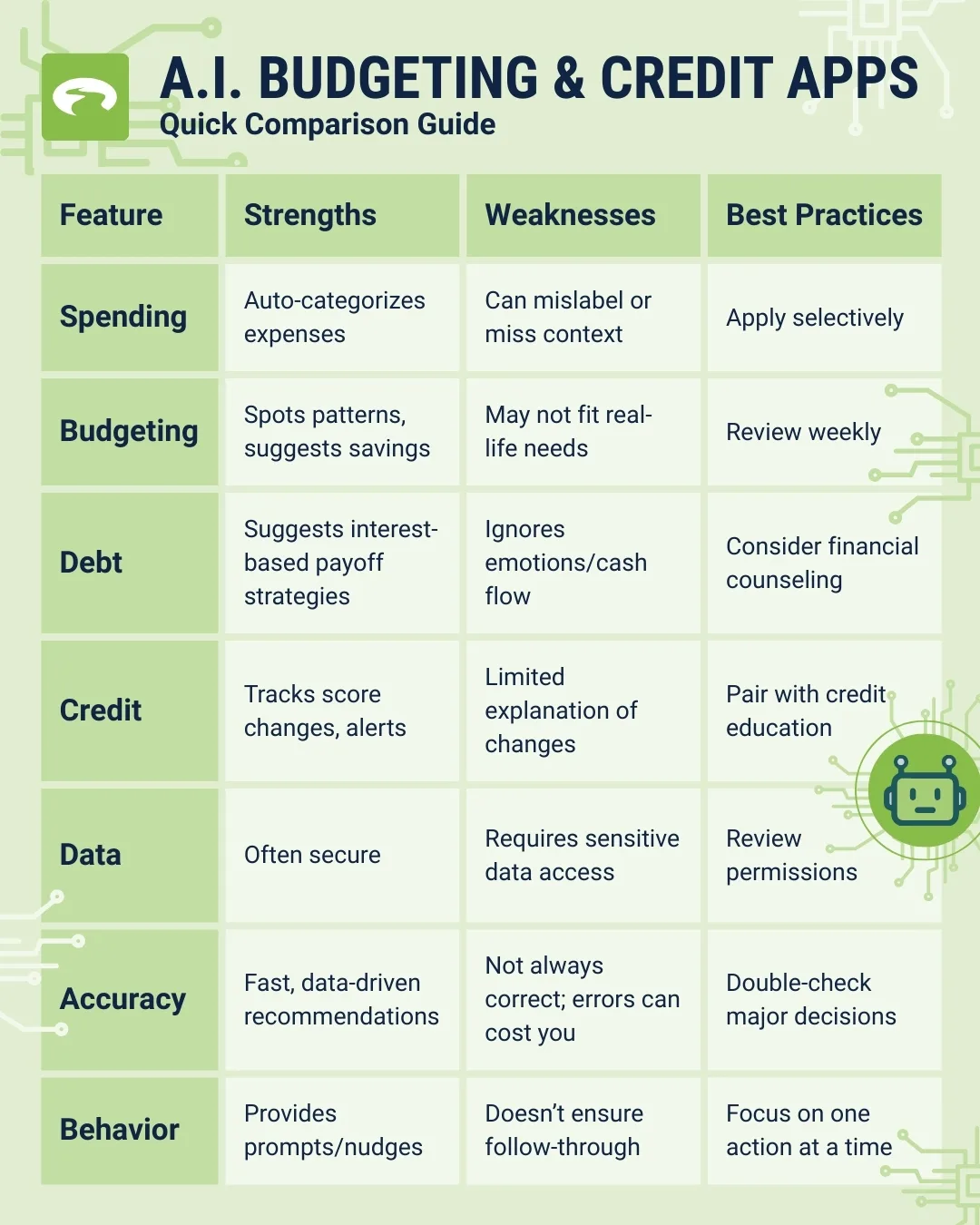
To work effectively, these apps often require access to your bank accounts, transactions, and spending behavior.
Before connecting your accounts, it’s worth asking:
- How is your data stored?
- Is it shared with third parties?
- What protections are in place if something goes wrong?
Even reputable tools vary widely in how they handle sensitive information—and once access is granted, it can be difficult to fully pull your data back. Convenience shouldn’t come at the cost of security.
2. Recommendations aren’t always complete
AI tools are built on patterns and probabilities, not your full life context.
They may suggest mathematically sound strategies, but miss factors like:
- Irregular income
- Family responsibilities
- Financial stress or competing priorities
What looks optimal on paper may not be realistic or sustainable in real life. AI can optimize numbers, but it doesn’t understand nuance.
3. Mistakes happen—and they can cost you
AI-generated advice isn’t always accurate.
In fact, nearly 1 out of 5 people who followed AI-generated financial advice reported losing money, according to a survey highlighted by Investopedia.
Errors don’t have to be dramatic to matter; small miscalculations, timing issues, or assumptions can still trigger fees or setbacks. That doesn’t mean AI is harmful, but it does mean it shouldn’t go unquestioned.
4. It’s easy to confuse activity with progress
This is one of the most common traps.
Using an app feels productive. Checking insights feels responsible.
But real progress comes from behavior changebehavior change: paying down debt, building savings, or sticking to a plan over time.
Without action, even the smartest tools won’t move the needle.
How to Use AI Budgeting Apps Wisely
If you’re using (or considering) AI-powered financial tools, a few simple habits can help you get more value, without the downsides.
Treat AI as a guide, not a decision-maker
Use it to surface ideas but apply your own judgment before acting.
Focus on one action at a time
Consistency matters more than complexity. Instead of trying to optimize everything, start small:
- Cancel one subscription
- Increase one payment
- Set aside a small emergency fund
Double-check major decisions
If an app suggests something big, like changing your debt strategy or reallocating money, pause and verify before moving forward.
Know when you need more support
If you’re dealing with high-interest debt, missed payments, or financial stress, an app alone may not be enough.
That’s not a failure. It’s a sign that you may need a more personalized plan.
Where Human Support Still Matters
AI budgeting and credit apps can be a powerful starting point. They can help you stay organized, spot patterns, and feel more in control of your finances.
But it doesn’t replace:
- Empathy
- Accountability
- Personalized guidance
A real conversation can help you:
- Prioritize what matters most
- Build a plan that fits your life
- Stay on track when motivation dips
That’s where GreenPath comes in.
Our NFCC- and HUD-certified financial counselors work with you to understand your full financial picture and create a plan that’s realistic, not just theoretical.
If you’re dealing with debt, they can also help you explore options like a Debt Management Program (DMP),Debt Management Program (DMP), which may reduce interest rates and simplify payments into one manageable monthly amount.
If you’re ready to move beyond tracking and start making meaningful progress, pairing those tools with trusted, human guidance can make all the difference.
GreenPath Financial Service
Debt Management Program
GreenPath is a 60-year trusted national nonprofit, learn how GreenPath’s Debt Management Program can help you pay off your debt in 3-5 years, while helping you develop sound financial literacy.