

Medical debt often feels overwhelming because it shows up unexpectedly, varies wildly in cost, and is tied to stressful health events.
You have more rights and options than you might realize—including the ability to negotiate bills, request financial assistance, or set up low or no interest payment plans or no interest payment plans.
GreenPath Financial Wellness can help you understand your full financial picture and create a personalized plan to manage and reduce your debtmanage and reduce your debt.
Why Medical Debt Is So Confusing (and So Common)
Medical bills arrive at the worst possible time—when you or someone you love is already dealing with health issues. Add complex billing systems, unclear insurance coverage, and high out-of-pocket costs, and it’s no surprise medical debt has become one of the most common forms of consumer debt in the U.S.ofpocket costs, and it’s no surprise medical debt has become one of the most common forms of consumer debt in the U.S.
To understand the scope of the issue:
- As of 2024, about 14 million Americans owe more than $1,000 in medical debt, according to the Kaiser Family Foundation—with at least $220 billion owed in total medical debt nationwide.
- A 2023 Consumer Financial Protection Bureau report found that medical collections tradelines accounted for 57% of all collections items on consumer credit reports—meaning that of the debts listed in collections on credit reports, a majority were for medical bills.
Those numbers paint a clear picture: medical debt isn’t a personal failure. It’s a systemic problem affecting people from all income levels, backgrounds, and health situations.
All that said…you’re not powerless. There are concrete steps you can take to make sense of medical debt and regain control of your financial health.
First, Understand What You Actually Owe
Medical bills are often confusing—and errors are far more common than most people realize. Before you pay anything, take time to verify that the charges are accurate and that you’re only being billed for what you truly owe.
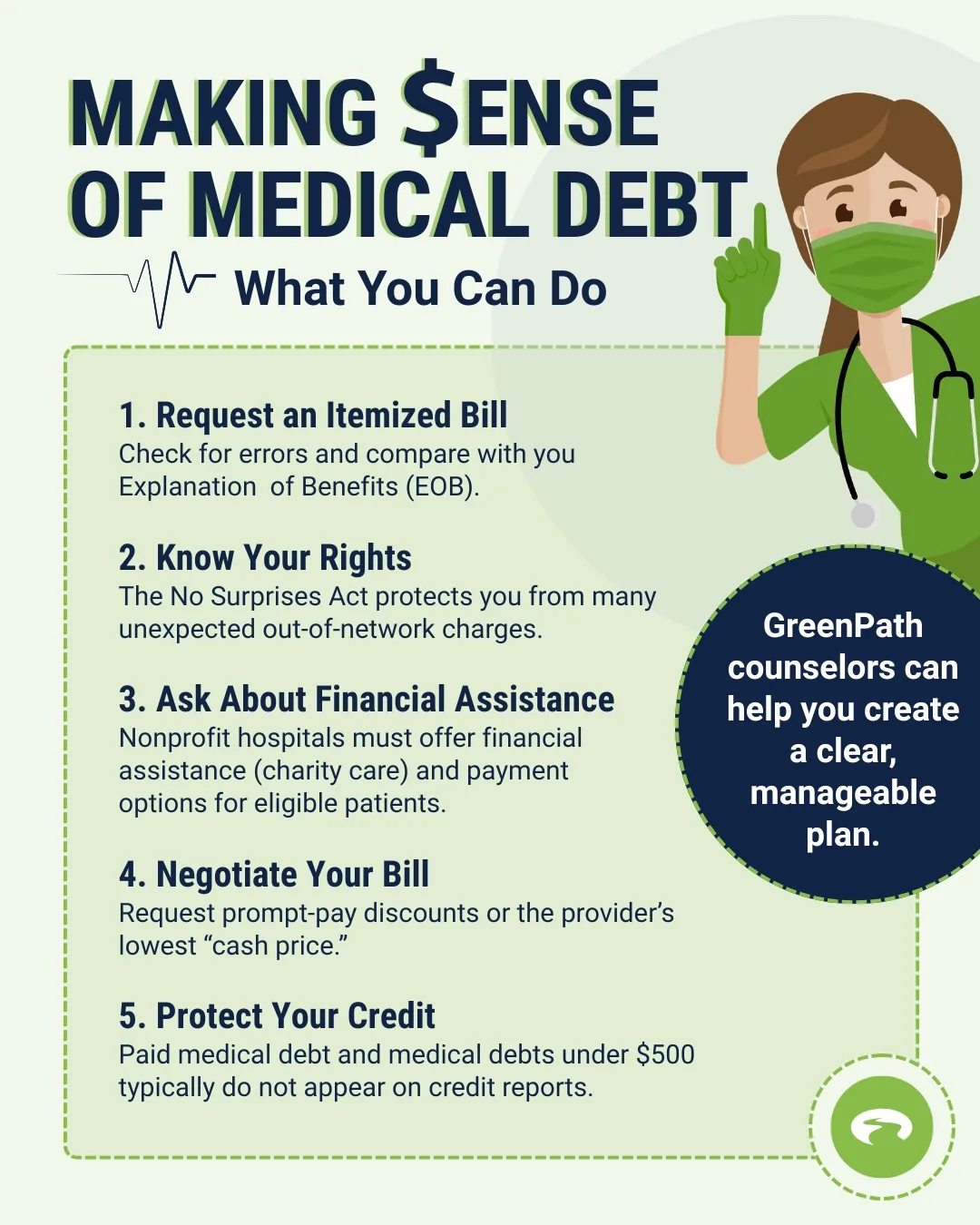
1. Request an Itemized Medical Bill
An itemized medical bill lists every charge individually, including medications, procedures, lab work, imaging, facility fees, and supplies. Without this breakdown, it’s nearly impossible to confirm accuracy.
Once you receive it, review the bill carefully and watch for common medical billing errors, such as:
- Charges for services or procedures you never received
- Duplicate charges for the same service
- Incorrect medical billing codes
- Out-of-network providers billed as in-network (or vice versa)
- Charges that should have been covered under preventive care
Correcting errors at this stage can significantly reduce your balance before any negotiation begins.
2. Compare the Bill to Your Explanation of Benefits (EOB)
Your Explanation of Benefits (EOB), issued by your insurance company, is not a bill—but it’s a critical tool for understanding your responsibility. It shows:
- What the provider charged
- What your insurance company approved and paid
- What portion is assigned to you (copays, coinsurance, or deductibles)
If the amounts on your bill don’t match your EOB, contact your insurance company first. Billing discrepancies are often the result of processing or coding errors that insurers can correct.
3. Request a Billing Review or Coding Audit
Most hospitals and clinics have billing advocates or patient financial services teams who can review disputed charges. If something doesn’t look right, request a formal review.
You can also ask whether the charges were coded correctly. Medical coding errors can affect how services are classified—and how much you’re billed—making this an important step when costs seem unusually high.
Know Your Patient Rights
Medical billing rules vary by state, but several federal protections apply nationwide and can help shield you from unfair or unexpected charges.
The No Surprises Act
The No Surprises Act, which took effect in 2022, protects patients from certain unexpected out-of-network medical bills. Under this law:
- You cannot be balance-billed for most emergency services, even if the provider is out of network
- Out-of-network specialists at in-network facilities must provide notice and obtain your consent before charging higher rates
If you receive a surprise medical bill that appears to violate these protections, you have the right to dispute it through the federal complaint and arbitration process.
Hospital Financial Assistance Requirements
Nonprofit hospitals are legally required to:
- Offer financial assistance (often called charity care) programs
- Publicly post eligibility guidelines
- Provide reasonable payment plans for qualifying patients
Many patients don’t realize they qualify. Depending on income and household size, financial assistance programs can reduce medical bills by 50% to 100%, even for people with insurance.
Negotiation Isn’t Just Possible—It’s Common
Medical bills are rarely fixed. Many providers expect patients to ask questions or request adjustments, especially if:
- You’re uninsured or underinsured
- You can pay part of the balance upfront
- You’re experiencing financial hardship
How to Negotiate a Medical Bill
You can start with a simple, direct request:
“I’d like to discuss options for reducing this bill. Are there financial assistance programs or prompt-pay discounts available?”
You can also:
- Ask for the cash price, which is often significantly lower
- Request a zero-interest payment plan
- Dispute charges that are inaccurate or excessive
In many cases, billing departments will reduce balances by 10% to 50% simply because you asked and documented hardship.
How Medical Debt Affects Your Credit
Medical debt is treated differently from other types of debtother types of debt, and recent changes have reduced its impact on credit reports—though it hasn’t been eliminated entirely.
Under current credit reporting practices:
- Paid medical collections no longer appear on consumer credit reports
- Unpaid medical collections are generally not reported until they have been unpaid for at least 12 months, giving patients time to resolve billing issues
- Medical debts under $500 are typically excluded from credit reporting
These changes reflect voluntary policies adopted by the three major credit bureaus. A broader federal rule proposed by the Consumer Financial Protection Bureau to remove most medical debt entirely from credit reports was blocked by a federal court and did not take effect.
If medical debt appears on your credit report that doesn’t meet these criteria—such as a paid collection or a balance under reporting thresholds—you may be able to dispute it with the credit bureaus.
Create a Plan to Move Forward
Medical debt can feel overwhelming, but a clear plan can restore control and reduce stress.
1. Prioritize Essential Expenses
Housing, utilities, food, and transportation should come firstHousing, utilities, food, and transportation should come first. Medical providers are generally more flexible than other creditors, particularly if you stay in communication and make consistent payments—even small ones.
2. Set Up Sustainable Payment Arrangements
Many hospitals offer:
- 0% interest payment plans
- Income-based monthly payments
- Medical hardship accommodations
Aim for a payment amount you can realistically maintain long-term, even if it feels modest.
3. Recheck Charity Care Eligibility
Even middle-income households may qualify for hospital financial assistance. Some programs extend eligibility to households earning 300–400% of the federal poverty level, depending on hospital policy and location.
4. Consider Whether Consolidation Helps
Traditional consolidation loans don’t reduce medical bills, but if you used credit cards to cover healthcare costs, consolidating high-interest credit card debt may reduce monthly payments and interest.
A nonprofit financial counselor can help you explore options without pressure or sales tactics.
When Medical Debt Leads to Credit Card Debt
Many people put medical bills on credit cards to buy time or avoid collections. Unfortunately, high interest rates can quickly turn a manageable balance into long-term financial strain.
If medical debt has led to credit card debt, GreenPath’s Debt Management Program (DMP)GreenPath’s Debt Management Program (DMP) may help by:
- Reducing interest rates
- Consolidating multiple payments into one
- Creating a structured path toward becoming debt-free
Many participants find their monthly payments become significantly more manageable.
You Don’t Have to Navigate Medical Debt Alone
Medical debt isn’t just financial—it’s emotional. Stress, shame, and uncertainty are common, but support is available.
GreenPath Financial Wellness offers:
- Free, confidential financial counselingfinancial counseling
- Help reviewing medical bills and understanding options
- Guidance on budgeting, repayment strategies, and saving
- Support exploring debt management solutions when appropriate
Whether you’re facing a single confusing medical bill or medical debt that has escalated into broader credit challenges, speaking with a counselor can provide clarity, relief, and a realistic path forward.
GreenPath Financial Service
Debt Management Program
GreenPath is a 60-year trusted national nonprofit, learn how GreenPath’s Debt Management Program can help you pay off your debt in 3-5 years, while helping you develop sound financial literacy.