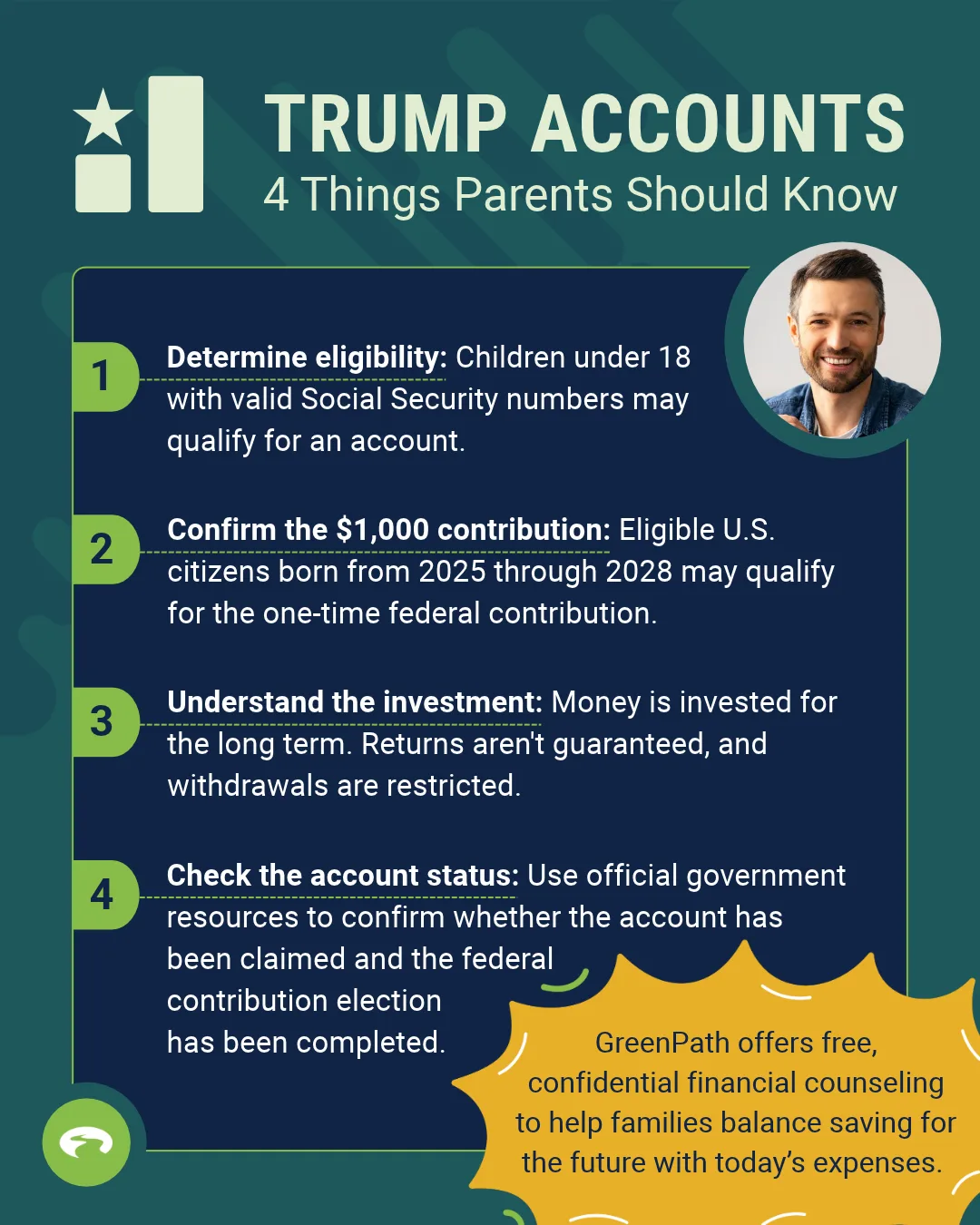
Trump Accounts are long-term investment accounts for children under 18 with valid Social Security numbers, with a one-time $1,000 federal contribution available to eligible U.S. citizens born between January 1, 2025, and December 31, 2028.
Families can add money to a Trump Account, but they should understand the investment risks, contribution limits and rules for accessing the funds before deciding whether to contribute.
If saving for your child feels difficult alongside everyday expenses, GreenPath offers free financial counseling to help you build a budget and plan for your family’s financial priorities.
If your child is eligible, a claimed Trump Account may receive a one-time $1,000 federal contribution with decades to potentially grow. That may sound straightforward, but before you count on the money for college, a first apartment or another future expense, it helps to understand how Trump Accounts actually work.
Also known as 530A Accounts, Trump Accounts are a new type of tax-advantaged investment account created under federal law. Eligible children born between 2025 and 2028 may receive a one-time $1,000 federal contribution.
Some parents may be considering the program as one way to invest for their children. Still, an investment account isn’t the same as a savings account, and qualifying for a government contribution doesn’t mean every family will see the same financial outcome.
What Is a Trump Account?
A Trump Account is a long-term investment account opened in a child’s name. It works much like a traditional individual retirement account (IRA), but special rules apply while the child is under 18.
The account’s money is invested rather than held as cash in a standard savings account. Investment earnings can grow tax-deferred, meaning taxes on those earnings are generally postponed until money is withdrawn, subject to the applicable rules.
A parent or other authorized adult serves as the account’s custodian while the child is a minor. The child is the account owner, but access to the funds is restricted during the account’s early years.
One important reality: the account’s value isn’t guaranteed to go up. Investments can lose value, and the amount available later will depend on investment performance, fees and when contributions and withdrawals are made.
Who Is Eligible for a Trump Account?
Any child under 18 with a valid Social Security number can be eligible for a Trump Account, provided the account’s establishment requirements are met. The $1,000 federal contribution has additional eligibility requirements.
The key is that eligibility for the account and eligibility for the $1,000 contribution aren’t exactly the same:
- Eligibility for an account: The child must not have turned 18 before the end of the calendar year in which the account election is made and must have a valid Social Security number.
- Eligibility for the $1,000 federal contribution: The child must be a U.S. citizen born between January 1, 2025, and December 31, 2028, have a valid Social Security number and be the qualifying child of the person making the election.
Families don’t have to contribute their own money for an eligible child to receive the federal contribution. Even if additional deposits aren’t in the budget, a child may still receive the contribution if they qualify and the required steps are completed.
How Does the $1,000 Trump Account Contribution Work?
The federal government’s $1,000 contribution provides a one-time initial investment for eligible children born from 2025 through 2028. The contribution may grow or lose value over time, depending on investment performance.
The contribution is invested in eligible investments rather than deposited into a traditional bank savings account. Under current rules, eligible investments generally include low-cost mutual funds or exchange-traded funds (ETFs) that track broad U.S. equity indexes.
The biggest potential advantage is time in the market. If the investments grow over the years, the initial $1,000 could be worth more by the time the child reaches adulthood. But returns aren’t guaranteed, and market declines can reduce the account’s value.
The $1,000 contribution is not available for families to spend today. A parent or guardian must claim the account and complete the required election process, and the account’s withdrawal restrictions still apply.
Are Trump Accounts Automatically Opened?
As of October 1, 2026, updated Treasury rules provide for automatic establishment of accounts for eligible children. However, a parent or guardian must claim the account before managing it or allowing most contributions, and the account must be claimed to receive the $1,000 federal pilot program contribution.
If you’re a parent or guardian, start by checking the child’s account status and confirming whether the pilot contribution election has been completed.
Families can use the official Trump Accounts app or visit TrumpAccounts.gov for current information. The IRS also provides guidance and access to Form 4547, Trump Account Election(s), through its Trump Accounts information page.
Be cautious about unsolicited messages claiming you must pay a fee to unlock a government contribution. Use official government websites and verified applications rather than links in unexpected texts or emails.
Can Parents and Family Members Contribute to Trump Accounts?
Yes. Families can contribute their own money to a child’s Trump Account, and eligible contributions can also come from sources such as relatives, friends, employers and certain government or philanthropic programs.
The general annual contribution limit is $5,000 per child through the end of the calendar year in which the child turns 17, subject to applicable rules and exceptions. The limit is adjusted for inflation. Employer contributions are generally limited to $2,500 and count toward the $5,000 annual limit. The $1,000 federal pilot program contribution does not count toward this annual limit.
Before anyone makes a deposit, it helps to know how different contributions are treated:
- Parents and relatives: Eligible individuals can contribute toward the child’s long-term investment balance, within the applicable limits.
- Employers: Eligible employer contributions may be available through workplace programs. Special rules apply, including how employer contributions count toward the annual limit.
- Government and nonprofit programs: Certain qualified contributions may be made under specific program requirements.
- Friends and other contributors: Contributions may be permitted, but the account’s rules and annual limit still apply.
Keep in mind that this isn’t a traditional savings account, and adding money doesn’t guarantee a particular return. If you choose to contribute, make sure the amount works with your household budget and doesn’t crowd out more immediate needs.
What Happens When a Child Turns 18?
Trump Accounts hold long-term investments and generally restrict withdrawals during the growth period, with limited exceptions under the applicable rules.
When the beneficiary reaches the relevant age threshold, the special growth-period rules generally give way to traditional IRA rules. Turning 18 does not necessarily make the full balance available without tax consequences; withdrawal treatment depends on the applicable rules and circumstances.
Keep Exploring
Check out these related GreenPath resources for more guidance:
- Should You Start a Savings Account for Your Child?:Should You Start a Savings Account for Your Child?: Explore how a children’s savings account can support financial habits and help your child learn about money.
- Strategies for Successful Saving:Strategies for Successful Saving: Explore practical ways to build savings, prepare for unexpected expenses and make progress toward your financial goals.
- Smart Planning for K–12 School Costs:Smart Planning for K–12 School Costs: Get practical tips for budgeting, saving and preparing for school-related expenses while balancing other family priorities.
Trump Accounts vs. 529 Plans and Savings Accounts
A Trump Account is one way to build financial resources for a child, but it isn’t the only one. The best fit depends on what you’re saving for, when you may need the money and how comfortable you are with investment risk.
A Trump Account holds long-term investments, may include a one-time federal contribution for eligible children and restricts withdrawals during the growth period.
A 529 planA 529 plan is a tax-advantaged account designed primarily for education expenses. Depending on the plan and the use of the funds, qualified withdrawals can receive favorable tax treatment. Families should review the plan’s rules and eligible expenses before contributing.
A children’s savings account can be a better fit for money that may be needed sooner. Depending on the account, funds may be more accessible and may earn interest rather than being exposed to stock-market fluctuations.
Before choosing, consider your goals, access needs, tax circumstances and ability to handle investment losses. A tax professional or qualified financial adviser can help you compare the options for your situation.
Should You Contribute Your Own Money to a Trump Account?
The federal contribution provides an initial investment for eligible children, but deciding whether to add your own money requires a review of your broader financial picture.
Start with what’s happening in your budget today. Are housing, utilities, food and other essentials covered? Are you keeping up with debt payments? Do you have at least some savings set aside for the unexpected?
If money is tight, you don’t need to stretch your budget to fund a child’s investment account. Contributing your own money is not a condition for receiving the federal contribution, and protecting your household’s current financial stability matters, too.
If there’s room in your budgetroom in your budget, think about how much you could contribute without putting other priorities at risk. It’s also worth comparing a Trump Account with other goals, such as building an emergency fund or contributing to an education savings account.
Check your child’s eligibility and account status first, then revisit additional contributions after reviewing your monthly expenses and savings goals.
Build a Financial Plan That Works for Your Family
Whether you’re thinking about saving for your child’s future or trying to make today’s expenses fit, GreenPath can help you explore your options with free, confidential financial counseling.