

Retirement planning is less about finding extra money and more about making consistent decisions that give your future self more options.
Every decade brings different priorities, but it is never too early or too late to improve your retirement outlook.
If retirement savings feels overwhelming because of debt, budgeting challenges, or competing financial goals, GreenPath’s financial counselors can help you create a plan that works for your real life.
Retirement planning can feel like one of those things you’ll get around to eventually. Right after you finish paying off student loans. Or when the kids are older. Or once you’ve landed the next promotion. Or when life becomes less expensive. (So… never?)
The reality is that retirement planningretirement planning is not a single event. It’s a series of small decisions made over decades. Thankfully, you do not need a six-figure salary, a finance degree, or a perfectly optimized investment portfolio to make meaningful progress.
In fact, one of the biggest advantages in saving for retirement is time. Even small retirement contributions can grow significantly when given years to compound.
And yet, many Americans still feel uncertain. The 2026 Retirement Confidence Survey from the Employee Benefit Research Institute and Greenwald Research found that “just over one in five Americans feel very confident about their ability to have enough money to live comfortably throughout their retirement years.”
That stress is understandable. Housing costs, healthcare expenses, caregiving responsibilities, and debt can all compete for the same paycheck.
Let’s break retirement planning down by age and focus on practical, realistic actions you can take at every stage of life.
Why Retirement Planning Matters at Every Age
Retirement planning is about more than reaching an arbitrary savings number.
It’s about creating future flexibility. The ability to decide when to retire. The freedom to work because you want to, not because you have to. The confidence to handle unexpected expenses without derailing your plans.
The encouraging news? Retirement plan design is helping more employees save. Vanguard’s 2026 “How America Saves” report found that participation reached a record 86% among eligible employees in the plans it administers, and 45% of participants increased their savings rate in 2025.
Whether you’re just starting to save for retirement or catching up later in life, your next step matters more than your current retirement account balance.
Retirement Planning in Your 20s: Build the Habit
Your twenties often involve first jobs, student loans, apartment hunting, and figuring out what you’re doing for dinner three nights from now. Retirement can seem impossibly distant.
But this decade offers one advantage you’ll never have again: time.
A dollar invested for retirement at age 25 has decades to grow. A dollar invested at age 55 has much less time to work.
What to Focus On
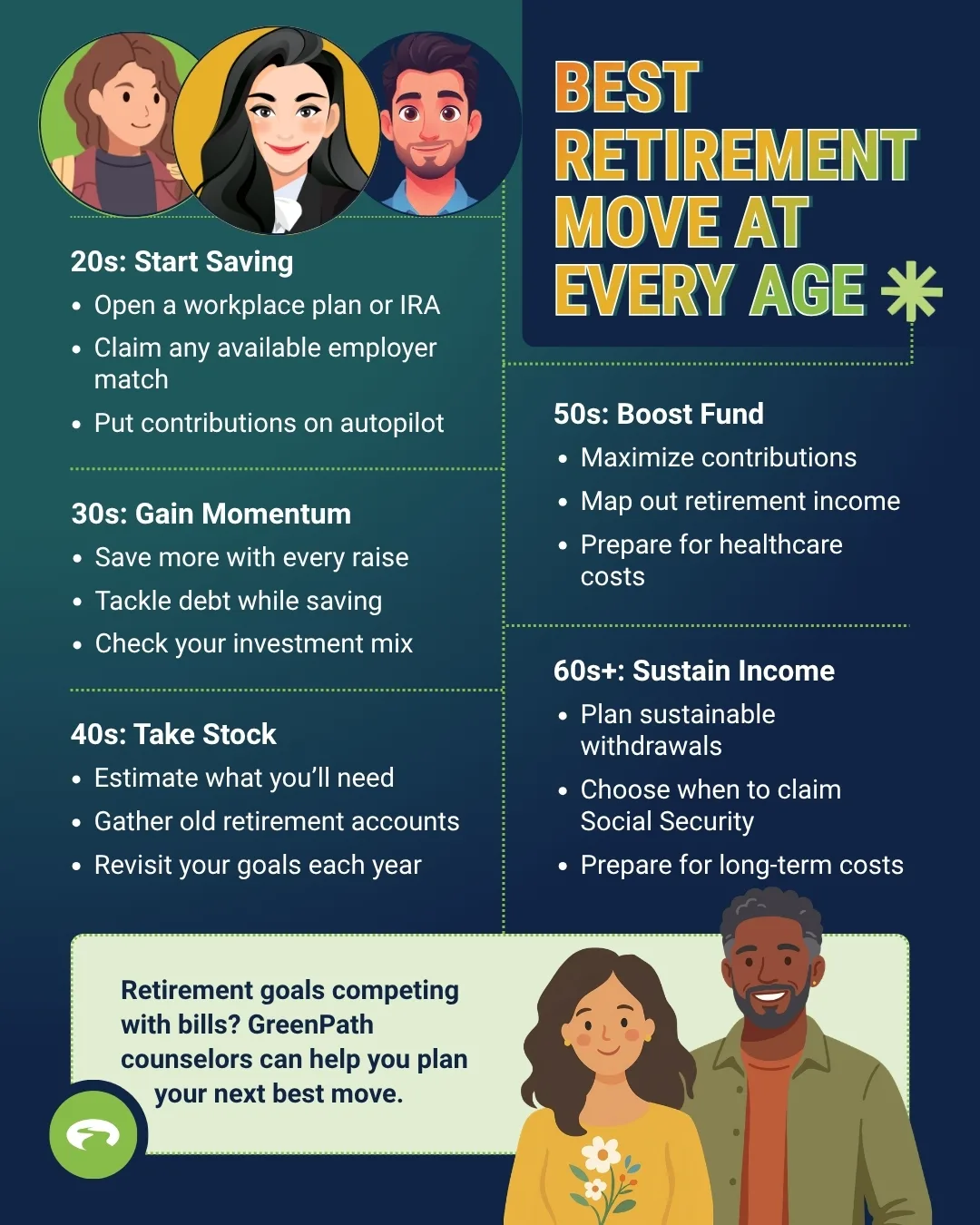
- Start saving for retirement with your employer’s plan if one is available. If your employer offers a 401(k) match401(k) match, try to contribute enough to receive the full match. Think of it as part of your compensation package.
- If a workplace retirement plan is not available, consider an IRA. Eligibility for a tax deduction on traditional IRA contributions and the ability to contribute directly to a Roth IRA can depend on income and tax-filing circumstances, so review current IRS rules before contributing.
- Just as importantly, create a budget that leaves room for long-term goals. Retirement savings becomes much easier when it is treated like a regular monthly expense rather than something you fund only when extra money appears.
A Practical Goal
Aim to save for retirement consistently, even if the amount is modest. Automatic retirement contributions of $25, $50, or $100 per paycheck can help establish habits that last for decades.
Retirement Planning in Your 30s: Balance Today’s Responsibilities with Tomorrow’s Goals
Your thirties often feel like a financial juggling act.
You may be building a career, raising children, purchasing a home, paying off debt, or supporting aging parents. Retirement can get pushed to the side while more immediate expenses demand attention.
This is also the decade when retirement savings contributions can begin to accelerate.
What to Focus On
- If your income has increased since your twenties, consider increasing your retirement plan contributions whenever you receive a raise.
- A simple strategy is to direct part of every future raise toward retirement before you become accustomed to spending it.
- Review your retirement investments periodically to ensure they align with your goals and risk tolerance.
- And if debt is consuming a large portion of your monthly budget, create a plan to address it. High-interest debt can make it difficult to consistently save for long-term goals.
A Practical Goal
Try increasing your retirement savings contribution rate by 1% annually. Small increases often feel manageable while creating meaningful long-term growth.
Retirement Planning in Your 40s: Take Inventory
By your forties, retirement may start feeling more real.
You may have accumulated savings, built home equity, or reached peak earning years. At the same time, college costs, caregiving responsibilities, and other financial pressures often intensify.
This is an ideal decade to step back and evaluate your overall retirement readiness and retirement savings progress.
What to Focus On
- Review all retirement accounts, including old 401(k)s from previous employers.
- Estimate how much retirement savings you may need. While the exact number varies, having a retirement savings target can help guide your decisions.
- Pay special attention to investment fees and asset allocation. Small adjustments can make a substantial difference over the long term.
- It is also wise to review insurance coverage, emergency savings, and estate planning documents as part of your broader financial strategy.
A Practical Goal
Schedule an annual “financial checkup” to review retirement contributions, savings balances, debt, and future goals.
Retirement Planning in Your 50s: Make the Most of Catch-Up Opportunities
Your fifties often represent a critical retirement planning decade.
Retirement is close enough to feel tangible, but there is still time to strengthen your retirement savings and overall financial position.
This is also when many people become eligible for catch-up contributions. Under 2026 IRS rules, people age 50 and older may be able to contribute beyond the standard limit to eligible workplace plans and IRAs. A higher workplace-plan catch-up limit applies to eligible participants ages 60 through 63. Limits and plan features vary, so check current IRS guidance and your plan’s rules.
What to Focus On
- Increase retirement savings wherever possible.
- Review retirement income projections and estimate future expenses, including healthcare costs.
- Consider your planned retirement age and whether adjustments are necessary.
- You may also want to begin thinking about Social Security timing and how it fits within your broader retirement income plan.
A Practical Goal
Direct bonuses, tax refunds, or additional income toward retirement savings when possible. These contributions can have an outsized impact during the final years before retirement.
Retirement Planning in Your 60s and Beyond: Shift Toward Income Planning
Retirement planning does not stop once you retire.
In many ways, the focus of retirement planning simply changes.
Instead of primarily accumulating assets, retirees begin planning how to generate income sustainably while managing market volatility, healthcare expenses, and changing financial needs.
What to Focus On
- Review Social Security claiming strategies and understand how benefit timing affects monthly income.
- Create a withdrawal strategy for retirement accounts.
- Evaluate healthcare coverage, Medicare decisions, and potential long-term care needs.
- Most importantly, revisit your plan regularly. Retirement can last 20 to 30 years or more, which means flexibility remains essential.
A Practical Goal
Build a retirement spending plan that reflects both essential expenses and the activities that bring you joy.
What If You’re Behind?
Recent retirement research points to a broad preparedness gap. In the 2026 EBRI/Greenwald Retirement Confidence Survey, worker confidence declined, with 61% feeling very or somewhat confident they would have enough money to live comfortably throughout retirement.
The important thing is to avoid letting regret become inaction.
The most effective retirement strategy is usually not a perfect one. It’s the one you can realistically sustain.
You Don’t Have to Figure It Out Alone
Here’s the part many retirement planning articles skip: lots of people feel behind on retirement savings.
Maybe you started saving for retirement later than planned. Maybe you experienced a job loss, divorce, medical crisis, or period of overwhelming debt. Maybe retirement savings simply weren’t your highest priority while managing more urgent financial demands.
You’re not alone.
Retirement planning intersects with nearly every part of your financial life. Debt, budgeting, emergency savings, housing costs, and day-to-day expenses all influence your ability to save for retirement and prepare for the future.
If you’re struggling to balance those competing priorities, GreenPath can helpGreenPath can help.
Our compassionate financial counselors can help you review your budget, explore strategies for managing debt, and create a retirement planning approach that supports both today’s needs and tomorrow’s goals. Whether retirement feels decades away or right around the corner, building financial confidence starts with understanding your options and taking the next step.
Because retirement planning is ultimately not about predicting the future. It’s about creating choices for yourself when the future arrives.
GreenPath Financial Service
GreenPath, A Financial Resource
If you’re interested in building healthy financial habits, paying down debt, or saving for what matters most, take a look at these free financial tools.