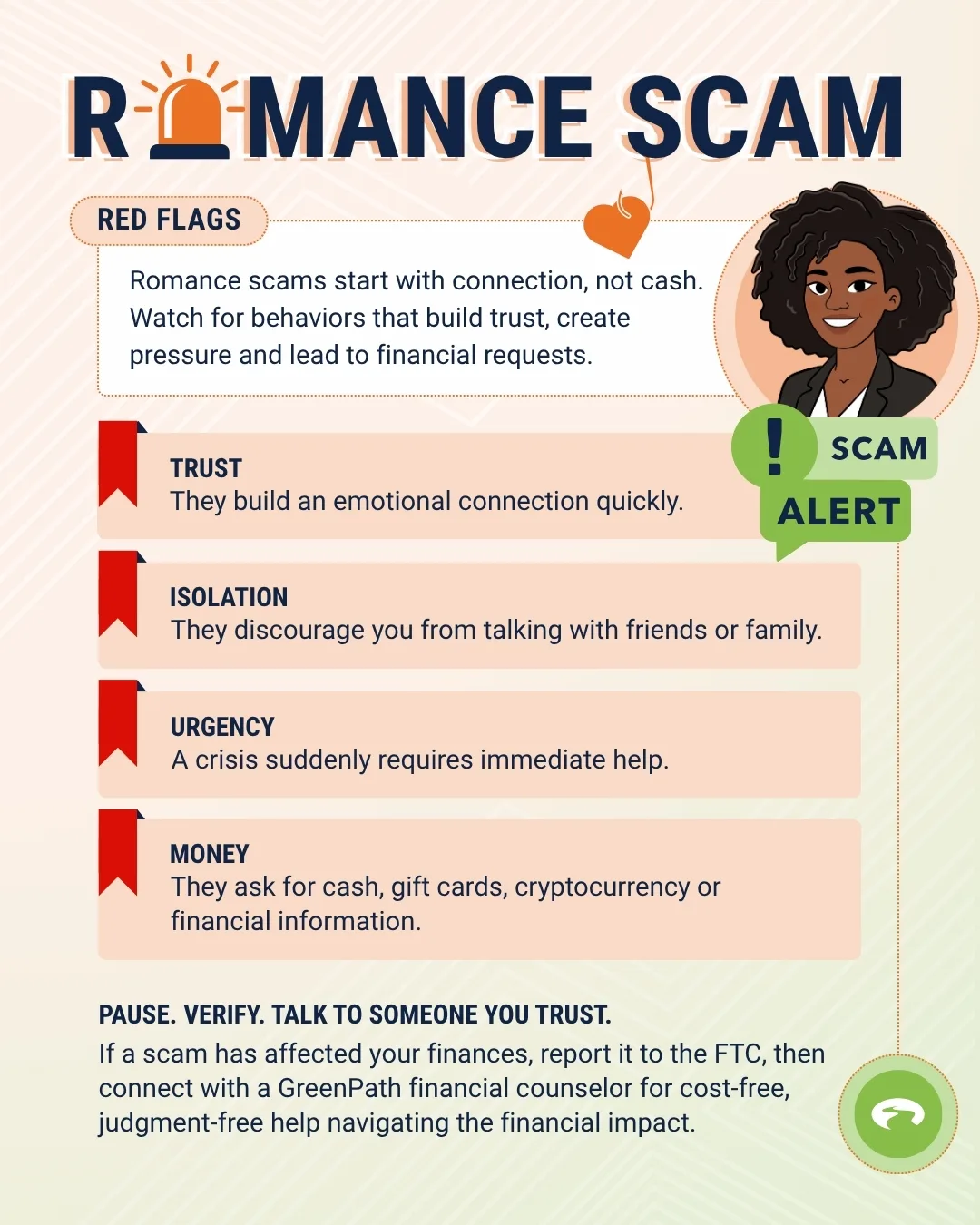

Romance scammers build emotional connections over time, then use that trust to make financial requests seem reasonable, urgent or even necessary.
Requests for money, cryptocurrency, gift cards or financial information are warning signs, especially when they come with pressure, secrecy or promises of repayment.
If a romance scam has affected your finances, GreenPath offers cost-free, judgment-free financial counseling to help you understand your situation and explore your options.
If you’ve sent money, act quickly. Ask your bank or payment provider whether the transaction can be stopped or reversed. Save evidence, then report the fraud to the Federal Trade Commission and, for internet-based crimes, the FBI’s Internet Crime Complaint Center (IC3).
The most convincing romance scams don’t start with a request for money. They start with a relationship.
A message becomes a conversation. The conversation becomes a daily routine. Before long, you may feel like you know the person on the other side of the screen.
That’s exactly what the scammer is counting on.
Romance scammers build trust first, then use it to make a financial request feel reasonable or urgent—whether it involves an emergency, loan, investment opportunity or help getting home.
The details change. The strategy doesn’t.
In 2025, nearly 60% of people who reported losing money to a romance scam told the Federal Trade Commission that the scam started on social media. Those social media-originated romance scam reports accounted for $298 million in reported losses.
What is a romance scam?
A romance scam is fraud in which someone creates a fake romantic or emotional relationship to gain your trust and steal money or sensitive information.
Scammers may contact people through dating apps, social media, messaging platforms or other online communities. They can use stolen photos, fake profiles and invented personal histories to make their identities seem legitimate.
The relationship may feel real even though the person isn’t who they claim to be—which is what makes romance scams difficult to recognize. Rather than simply pushing a suspicious link, the scammer is trying to become someone you trust.
How do romance scams work?
Romance scams often follow a familiar pattern.
First comes the connection. The person may seem unusually attentive, interested and available. They may remember small details about your life and communicate with you frequently.
Next comes emotional investment. The relationship may become serious quickly. The person might talk about a future together or say they have never connected with someone in quite the same way.
Then something changes.
The person has an emergency. They can’t access their bank account. They need help paying a bill. They’re traveling and can’t get home. Or they introduce an investment opportunity that supposedly could benefit you both.
The request for money may feel like an isolated event. In reality, it’s often the point of the scam.
The Federal Trade Commission says romance scammers may use information from social media profiles to build connections, then invent a crisis requiring money or introduce investment advice that directs the person to a fake investment platform.
A 2026 AARP survey found that 1 in 10 adults age 50 and older had an online romantic connection that led to a request for money or cryptocurrency; about one in six said they or someone they know had lost money to a romance scam.
Romance scams can affect anyone, however. The warning signs are more important than the age or background of the person being targeted.
6 romance scam warning signs to watch for
There isn’t one type of person who becomes a romance scammer. Instead of focusing on who someone claims to be, pay attention to the behavior and the requests.
1. They avoid meeting or verifying their identity
A person you’ve met online may have legitimate reasons for not meeting right away. But a consistent pattern of avoiding video calls, in-person meetings or other reasonable ways to verify their identity deserves attention.
Work overseas, family emergencies or delayed travel may explain why they can’t meet—but one excuse doesn’t prove fraud. A pattern is worth noticing.
2. The relationship moves very quickly
Strong feelings can develop online, but scammers may deliberately accelerate a relationship.
They might use intense language early on, talk about a future together or make you feel that the relationship is unusually special before you’ve had much opportunity to know each other.
If someone is pushing the relationship forward faster than feels comfortable, slow things down.
3. They want you to keep the relationship private
A scammer benefits from isolation.
Be cautious if someone you’ve met online tells you that your friends or family don’t understand the relationship, discourages you from talking about them or asks you to keep financial requests secret.
An outside perspective can be valuable because someone who isn’t emotionally involved may notice inconsistencies that are difficult to see from inside the relationship.
4. They suddenly have a financial emergency
The emergency might involve medical expenses, travel, a family problem, a frozen bank account or another unexpected bill, often with a promise of repayment.
The story may sound believable. That’s why the safest response is not to decide whether the story is true. Instead, pause before sending money.
5. They ask for hard-to-recover payments
Be especially cautious if someone you’ve only met online asks for cryptocurrency, gift cards, a wire transfer or payment through an app. These methods can make recovery difficult.
Investment pitches deserve particular caution. The FTC warns against letting someone you met through social media direct your investment decisions, even if the person presents themselves as a romantic partner or trusted confidant.
6. They ask you to take financial action on their behalf
A request doesn’t always involve sending money directly to the person.
They may ask you to open an account, receive money and transfer it somewhere else, deposit a check, share your banking credentials or provide sensitive financial information.
Don’t allow someone you’ve only met online to use your bank account or financial accounts. You could become involved in another type of fraud without realizing it.
Keep Exploring: GreenPath Identity & Scam Resources
Check out these related GreenPath resources for more guidance:
- Identity Theft, Fraud, and Scams – Online Course:Identity Theft, Fraud, and Scams – Online Course: Build practical skills to spot scams, protect your personal information, and respond if you’re targeted.
- Protect Yourself from Scams:Protect Yourself from Scams: Get tips for verifying suspicious communications, safeguarding account information, and recognizing pressure tactics.
- Avoiding Identity Theft and Scams – Recorded Webinar:Avoiding Identity Theft and Scams – Recorded Webinar: Learn how scammers use phishing, deepfakes, and imposter tactics, plus steps to protect your personal and financial information.
- Secure Your Digital Wallet: Tips for Safe Online Shopping and Payments:Secure Your Digital Wallet: Tips for Safe Online Shopping and Payments: Get practical tips for safer online payments, stronger account security, and protecting sensitive financial information.
What should you do if someone you met online asks for money?
Pause before you send anything.
Urgency makes a situation harder to evaluate. Step away, give yourself time and verify the person’s story independently.
Don’t rely on contact information they provide. If they claim to work for a company, find its official website and contact details yourself.
You can also search for the person’s name, photos or details about their story. These checks can’t guarantee that someone is legitimate, but they may reveal inconsistencies.
Most importantly, talk to someone you trust.
Tell a friend or family member what’s happening, even if you’re embarrassed. You don’t have to determine whether you’re being scammed on your own.
What should you do if you sent money to a romance scammer?
If you’ve sent money to a romance scammer, act quickly.
Contact the bank, credit card company or payment service you used. Explain that you believe you were defrauded and ask whether the transaction can be stopped or reversed.
Save messages, receipts, account information, profile names and other evidence. These records may help when reporting the fraud.
You can report fraud to the Federal Trade Commission at ReportFraud.ftc.gov. Internet-based crimes can also be reported through the FBI’s Internet Crime Complaint Center at IC3.gov.
If you’re in the U.S., your financial institution can also tell you what steps may be available for the particular payment method you used.
And tell someone you trust.
Romance scams can leave people feeling embarrassed or ashamed, which can make them less likely to ask for help. But being targeted by a scam doesn’t mean you were foolish. Romance scammers deliberately use deception and emotional manipulation to gain trust.
How can you protect your finances from a romance scam?
You don’t have to stop using dating apps or social media. Set financial boundaries before you need them.
Don’t send money to someone you’ve only met online, particularly when the request is urgent, secretive or tied to a promise of repayment or an investment opportunity.
Don’t share your banking credentials, passwords, Social Security number or other sensitive financial information with a new romantic interest. Be cautious about sending photos of identification or financial documents, too.
You can also make a personal rule that a new romantic relationship doesn’t get to make your financial decisions for you.
If someone encourages you to invest, take out a loan, open a credit card, move money or send cryptocurrency, get a second opinion from someone outside the relationship first.
That pause gives you something a scammer doesn’t want you to have: time to think.
What if a romance scam has affected your finances?
After a romance scam, you may face credit card balances, depleted savings, unfamiliar transactions or bills that are harder to cover.
After contacting your financial institution and reporting the fraud, consider the broader financial impact. If the loss has created debt or strained your monthly budget, support is available for that part of recovery, too.
Credit counselingCredit counseling can help you understand your overall financial picture and explore potential strategies for managing debt. You don’t need to know which solution you need before talking with a counselor.
GreenPath offers cost-free, judgment-free financial counseling with NFCC-certified counselors. A counselor can review your income, expenses and debts with you and help you understand potential next steps.
If credit card debt has become difficult to manage, a counselor can also explain whether a Debt Management ProgramDebt Management Program may be appropriate for your situation.
A Debt Management Program is not a loan or debt settlement. For eligible unsecured debts, it offers a structured repayment path through one monthly payment. Depending on the creditor, concessions may include reduced interest rates or waived fees.
The important point is that you don’t have to figure out the financial aftermath alone.
Get Personalized Help After a Romance Scam
Has a romance scam affected your finances? GreenPath’s financial counselors can help you review your budget and debts, understand your options and identify practical next steps—without judgment.