
The true cost of homeownership includes much more than a mortgage payment, making proactive budgeting essential.
Building maintenance savings into your monthly spending plan can help prevent financial stress when repairs and emergencies arise.
If homeownership costs are stretching your budget, GreenPath’s housing and financial counseling services can help you create a plan with confidence.
Buying a home can create stability and build your future. But after closing day, many homeowners discover a less-discussed reality: houses generate expenses when you least expect them.
A water heater fails. A storm damages the roof. Property taxes rise. An aging HVAC system needs replacement during the hottest week of summer.
These surprises do not mean buying a home was a mistake. They show why successful homeownership requires preparation beyond the mortgage payment.
The Hidden Costs of Owning a Home
Many first-time buyers calculate affordability around the mortgage payment. But homeowners also face property taxes, insurance, utilities, maintenance, landscaping, appliance replacement, and emergency repairs.
Recent research shows just how common these surprises are. According to Bankrate’s 2025 Homeowner Regrets Survey, among homeowners who reported regret about their home purchase, 42% said maintenance and hidden costs ended up being more expensive than expected.
Similarly, U.S. News’ 2025 U.S. Homeowner Survey Report found that 60% of homeowners identified unexpected repairs to essential systems such as roofing, HVAC, electrical systems, or appliances as a top concern, while 47% worried about facing a major unexpected repair within the next year.
Unexpected costs are common—and planning for them is part of owning a home.
Why Budgeting for Homeownership Is Different
Traditional budgets focus on recurring expenses: mortgage, utilities, internet, and other monthly bills. Homeownership is different because many major costs are irregular.
Instead of asking only, “What are my monthly housing costs?” also ask:
“What are my monthly housing costs—and how much should I set aside for future repairs and maintenance?”
This mindset can help reduce reliance on high-interest credit when a major repair arrives.
Build a Home Repair Emergency Fund
A dedicated home maintenance fund helps you prepare for repairs and upkeep without drawing from savings reserved for other emergencies.
Set aside money each month for repairs and maintenance. Even modest contributions create a useful buffer over time.
For example:
- $50 per month becomes $600 in a year.
- $100 per month becomes $1,200.
- $200 per month becomes $2,400.
These amounts may not cover every repair, but they can reduce the financial shock.
Keeping home-repair savings separate from general savings can make the money easier to track and less tempting to use for other expenses.
How Much Should You Budget for Home Maintenance?
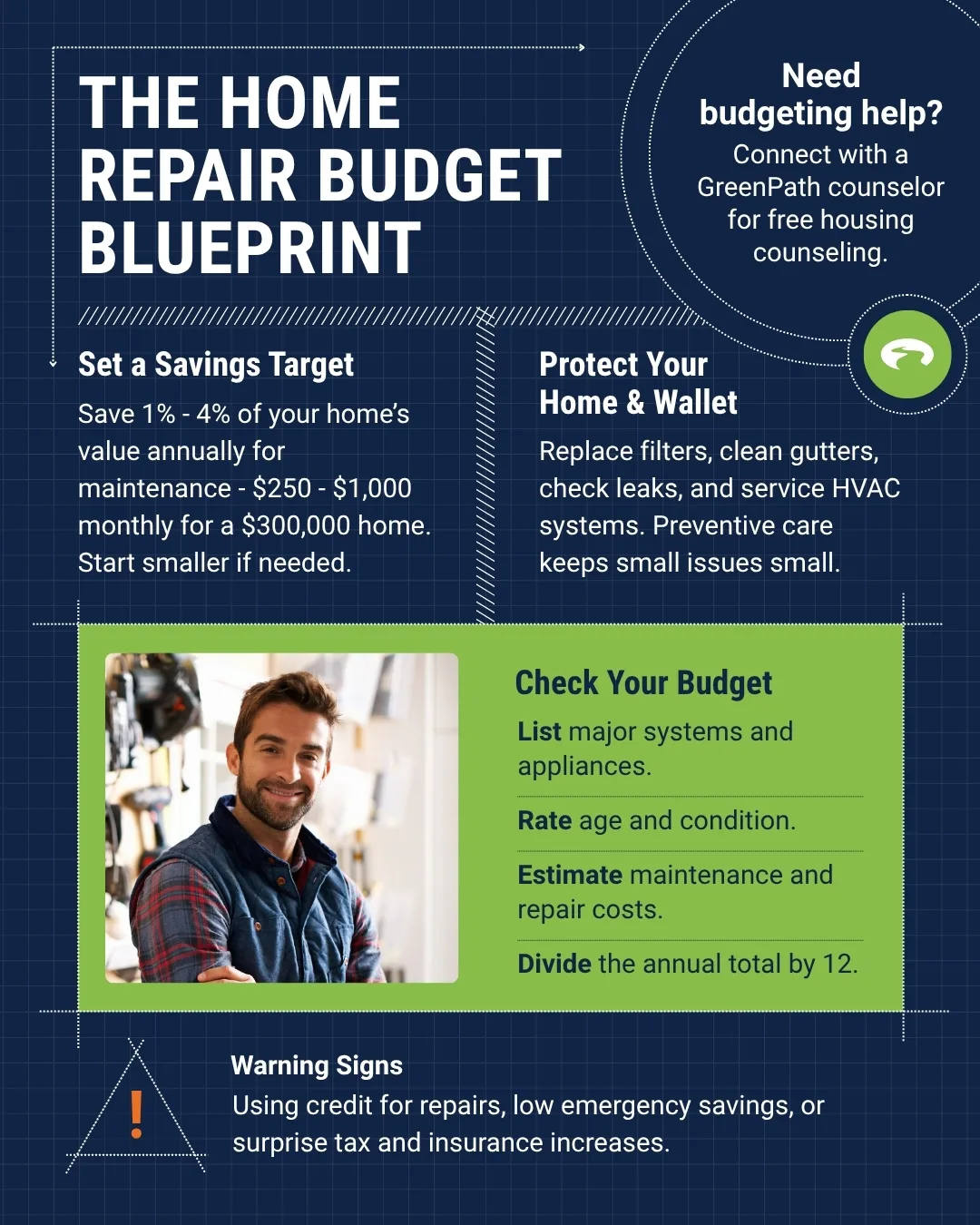
A common starting point is to save a percentage of your home’s value each year for maintenance and repairs. Redfin’s December 2025 guide recommends a range of 1% to 4%, adjusted for the home’s age, size, and location. For a $300,000 home, 1% to 4% equals $3,000 to $12,000 a year, or about $250 to $1,000 a month. Use this as a planning range and choose an amount that fits alongside essential expenses, debt payments, and other goals.
Adjust your target for the home’s condition, climate, and the remaining lifespan of the roof, HVAC, plumbing, electrical system, and appliances. If the full amount is unrealistic, start smaller and increase it when your budget allows.
GreenPath Home Maintenance Budget Check
Use this four-step check to set a monthly goal:
- List: Note your roof, HVAC, water heater, plumbing, electrical system, and major appliances.
- Rate: Mark each as newer, midlife, or nearing replacement.
- Estimate: Add annual maintenance and likely repair or replacement costs.
- Divide: Divide the yearly total by 12, then adjust for your cash flow.
Review the plan yearly—or after a major repair, insurance change, or home improvement.
Create a Sinking Fund for Home Repairs
Some housing expenses are predictable. An aging HVAC system, dated appliances, or exterior paint may need attention within a few years.
A sinking fund lets you save gradually for those known costs. If the roof may need replacement in five years, setting aside small amounts now can make the expense more manageable.
Keep Exploring: GreenPath Homeownership Resources
Explore these GreenPath resources for more homeownership guidance:
- Homebuyer Hacks – Recorded Webinar:Homebuyer Hacks – Recorded Webinar: Learn how to prepare, understand mortgage basics, and navigate the buying process.
- To Buy or Not to Buy:To Buy or Not to Buy: Weigh whether homeownership fits your goals and budget.
- The Definitive Guide to Housing Resources:The Definitive Guide to Housing Resources: Find guidance for buying, maintaining, or managing financial strain.
- Housing 101:Housing 101: Take self-paced lessons on readiness, mortgages, agents, applications, and closing.
Look Beyond Home Repairs
Unexpected costs extend beyond repairs. Homeowners may also face:
- Rising insurance premiums
- Property tax increases
- Higher utility costs
- HOA assessments
- Storm preparation expenses
- Seasonal maintenance needs
During your annual budget review, compare these costs with the prior year and plan for increases. Flexibility today can reduce surprises tomorrow.
The Value of Preventive Home Maintenance
Preventive maintenance can keep small issues from becoming expensive emergencies.
- Replacing HVAC filters regularly
- Cleaning gutters before seasonal storms
- Checking caulking around windows and doors
- Inspecting plumbing for leaks
- Servicing heating and cooling systems annually
These steps can extend the life of major systems and help protect both your home and your financial wellness.
Signs Your Homeownership Budget Needs Attention
Your housing budget may need adjustment if:
- You regularly rely on credit cards to cover repairs.
- You have little or no emergency savings.
- A repair bill would force you to miss other essential payments.
- Property taxes or insurance increases catch you off guard each year.
- You’re unsure how much your home actually costs to maintain annually.
These signs do not mean you have failed; they are prompts to strengthen your plan before a larger challenge arises.
Homeownership Is a Journey, Not a Test
Successful homeowners do not have everything figured out. They prepare for surprise expenses and adjust when the budget feels tight.
Build emergency savings, plan for maintenance, review your budget regularly, and address small issues early. These habits cannot prevent every surprise, but they can help you handle unexpected costs with less disruption and more confidence.
Get Personalized Help with Your Housing Budget
Homeownership costs stretching your budget? GreenPath’s financial and housing counselors can help you review housing expenses, debt payments, emergency savings, and home maintenance goals—and identify practical next steps.