
Federal student loan repayment has fully resumed, making it important to understand your repayment plan, loan servicer, and current loan status.
Missing student loan payments can lead to delinquency, credit score damage, and collection activity, making early action critical.
If student loan debt is making it harder to manage your budget or other financial goals, GreenPath’s financial counselors can help you create a personalized plan.
Student loans can feel like road construction: just when you think you’ve figured out the detour, another sign points you in a different direction. Their impact also extends well beyond the monthly bill.
In a 2026 SoFi survey of 1,000 U.S. adults with federal or private student loans, nearly 70% said student loan debt had held them back in life, while about 63% said it significantly limited or prevented them from saving for the future.
Those pressures show up in day-to-day decisions: roughly 60% of respondents said student debt had influenced their career or job choice, and 55.5% said it had affected where they chose to live. The survey also found that more than half of borrowers had missed or made a late student loan payment at least once.
Whether you’re trying to lower your monthly payment or avoid student loan delinquency, you don’t need to become a student loan expert to make smart choices. A few practical steps can help you avoid costly mistakes and keep your broader financial goals in focus.
Federal Student Loan Repayment in 2026: What’s Changed?
For many borrowers, 2026 is the first year in quite some time that student loans feel fully back.
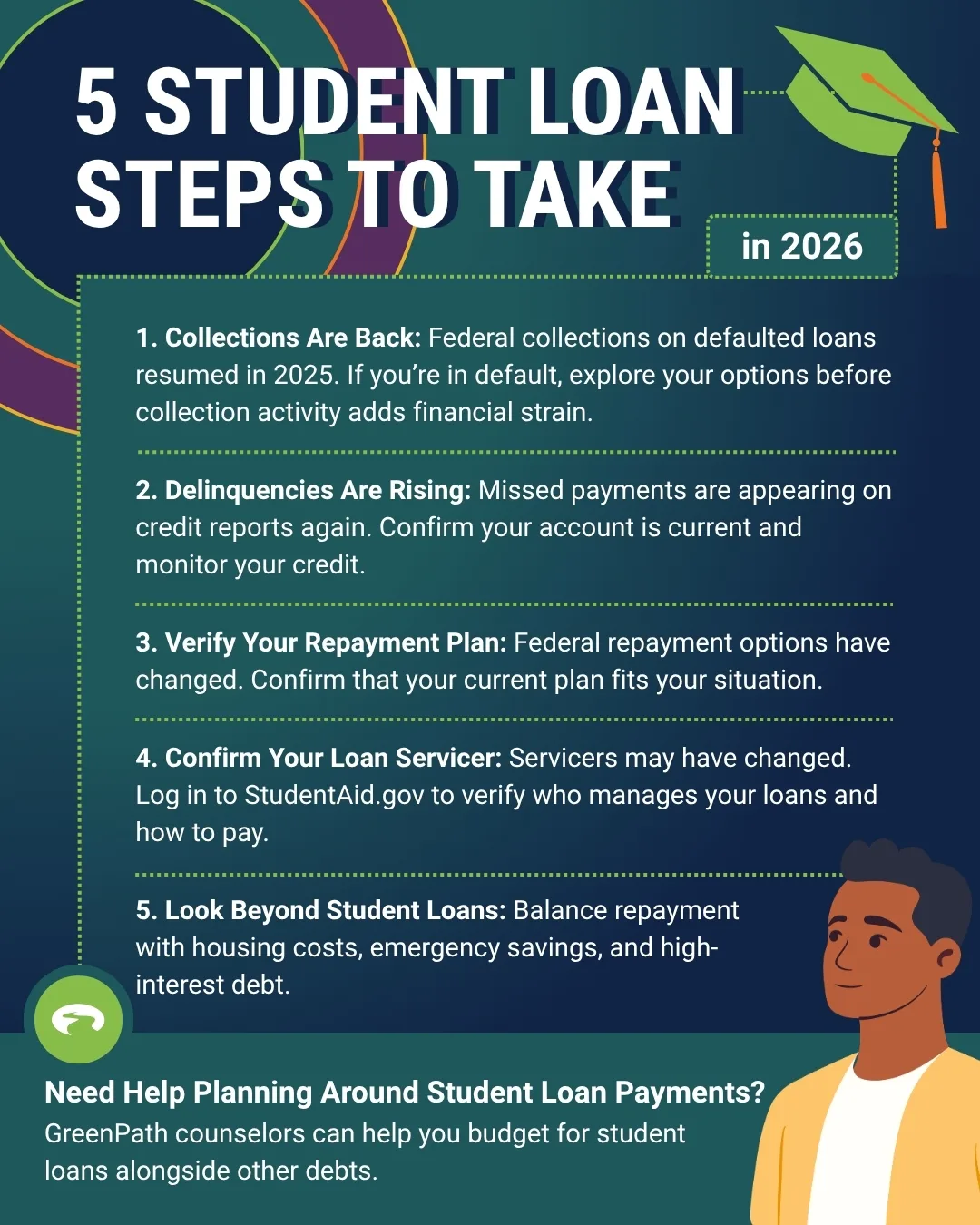
The pandemic-era payment pause is over. Collections on defaulted federal student loans resumed in 2025Collections on defaulted federal student loans resumed in 2025, and many borrowers are once again seeing student loan activity reflected on their credit reports. At the same time, repayment programs and forgiveness options have continued to evolve, creating confusion about what programs are available and which rules apply.
According to Federal Student Aid data through June 2025, approximately 42.3 million recipients held $1.67 trillion in outstanding federal student loans. Student loans remain one of the largest categories of consumer debt in the country.
The result is a lot of uncertainty, even among borrowers who have consistently stayed current on payments.
If you’ve found yourself wondering whether you’re enrolled in the right repayment plan, eligible for forgiveness, or at risk of falling behind, you’re far from alone.
Student Loan Delinquency Is Rising: What Borrowers Should Know
One of the biggest student loan developments in 2026? The return of delinquency reporting.
During the pandemic-era payment pause, many borrowers had little reason to worry about missed payments impacting their credit. That’s no longer the case.
After missed payments began appearing on credit reports again, the share of student loan balances past due rose to just over 10% in the first quarter of 2026, nearing pre-pandemic levels, according to New York Fed data.
Why does this matter?
Student loan delinquency can affect far more than your student loans. Late payments may damage your credit score, potentially making it more difficult to qualify for a mortgage, auto loan, apartment rental, or other forms of credit.
How to Check Your Student Loan Status and Repayment Plan
Before researching student loan forgiveness or comparing repayment plans, start with a simple but important step: understand your current situation.
| Check | What to confirm |
|---|---|
| Loan balance | The amount you currently owe |
| Loan servicer | The company managing your loan and payments |
| Repayment plan | The plan currently listed and whether it fits your situation |
| Account status | Whether your loan is current, delinquent, or in default |
| Next payment | The amount due and payment date |
Many borrowers are surprised to discover that their servicer has changed, their contact information is outdated, or they’re enrolled in a different repayment plan than expected.
Understanding Your Student Loan Repayment Options
One common misconception about federal student loans is that every borrower has the same repayment choices.
Federal repayment options depend on current rules, loan type, and borrower eligibility. Options may include Income-Based Repayment (IBR), Pay As You Earn (PAYE), Income-Contingent Repayment (ICR), and the Repayment Assistance Plan (RAP), when available and applicable.
Income-driven repayment plans can help borrowers align monthly payments with income and family size. For some households, this can make repayment more manageable and reduce the risk of delinquency.
However, lower monthly payments can sometimes result in longer repayment periods or additional interest costs over time. Before making changes, it’s worth comparing the full financial impact of different options.
The Department of Education’s Student Loan Calculator remains one of the most useful tools for evaluating repayment scenarios.
What to Do If You’re Behind on Student Loan Payments
Many borrowers avoid checking student loan emails because they’re worried about what they’ll find.
Unfortunately, ignoring the issue rarely improves the outcome.
When federal student loans become seriously delinquent or enter default, the consequences can become more significant. Depending on the situation, borrowers could face tax refund offsets, wage garnishment, or other collection actions permitted under federal law.
The Department of Education reported that more than 5 million borrowers were already in default when collections resumed in 2025, with millions more considered at risk.
If you’re struggling to keep up with student loan payments, it may be worth exploring possible solutions such as loan rehabilitation, loan consolidationloan consolidation, or a different repayment plan before delinquency becomes more severe.
The earlier you act, the more options you’re likely to have available.
Don’t Let Student Loans Crowd Out Your Other Financial Goals
When student loan payments increase, it’s easy to focus on them exclusively.
But student loans are only one part of your financial picture.
You may also be balancing:
- Housing expenses
- Credit card debt
- Emergency savings
- Retirement contributions
- Medical expenses
- Family obligations
For example, if you’re aggressively paying down student loans while carrying high-interest credit card debthigh-interest credit card debt, it may make sense to evaluate your overall debt payoff strategy rather than focusing on one balance in isolation.
That’s why budgeting remains one of the most effective tools for managing student loan debt.
Check your full financial picture:
- Confirm that your current student loan payment fits your monthly budget.
- Identify which debt is costing you the most in interest.
- Set a realistic emergency savings goal.
- Decide how you would cover an unexpected expense.
- Choose one next step to take this week.
Student Loan Forgiveness in 2026: What Programs Still Exist?
Student loan forgiveness remains one of the most searched student loan topics, but it is also an area where misinformation spreads quickly. There is no universal federal forgiveness program for every borrower in 2026. Relief generally depends on your employer, repayment history, loan type, or other qualifying circumstances.
Among the federal programs borrowers commonly research are:
- Public Service Loan Forgiveness (PSLF): Eligible government and nonprofit employees may have the remaining balance on qualifying Direct Loans forgiven after the equivalent of 120 qualifying monthly payments while working full time for an eligible employer.
- Income-driven repayment forgiveness: Borrowers enrolled in an eligible income-driven repayment plan may qualify to have a remaining federal loan balance discharged after 20 or 25 years of repayment, depending on the plan and loan type.
- Teacher Loan Forgiveness: Eligible teachers who work full time for five complete and consecutive academic years at a qualifying low-income school or educational service agency may receive up to $5,000 or $17,500 in forgiveness on certain federal loans. The same period of teaching service cannot count toward both Teacher Loan Forgiveness and PSLF.
Before pursuing forgiveness, check your loan type, employer eligibility, repayment history, and current program rules through StudentAid.gov. Your loan servicer can provide account information, but official federal guidance is the best place to confirm whether a program applies to your situation.
Your Next Best Step Might Not Be About Student Loans at All
Sometimes the challenge isn’t the student loan itself.
It’s the fact that student loans are competing with everything else in your financial life.
Rent. Credit card balances. Childcare. Medical bills. Emergency savings. Retirement planning.
When multiple priorities are pulling on the same paycheck, it can be difficult to know where to start. A broader financial wellness strategy can help you identify what deserves your attention first and how student loan repayment fits into your overall goals.
| If this sounds like you | Start here | Why it matters |
|---|---|---|
| I’m not sure who services my loan. | Log in to StudentAid.gov. | Confirm your servicer, balance, and payment details. |
| My payment is unaffordable. | Review repayment options. | A different eligible plan may better align with your income and family size. |
| I’ve missed payments. | Contact your servicer promptly. | Acting early may help you understand available options before the situation becomes more severe. |
| Student loans are crowding out other goals. | Review your full budget. | Looking at all debts and expenses together can help you prioritize. |
| I’m overwhelmed. | Talk with a financial counselor. | A counselor can help you organize your options and identify a manageable next step. |
You Don’t Have to Navigate Student Loan Debt Alone
Student loan policies can change. The most reliable approach is to understand your options, stay engaged with your loans, and act early when challenges arise.
Whether you’re looking for help with student loan debt, budgeting, credit card balances, or building a long-term financial plan, GreenPath’s compassionate, NFCC-certified financial counselorsNFCC-certified financial counselors can help you evaluate your options and move forward with confidence. Financial progress doesn’t require having every answer today. Sometimes it starts with a conversation that helps you identify the next right step.
GreenPath Financial Service
Resources for Students and Graduates
If you’re starting college or is now repaying your student loans, take a look at these resources from GreenPath. These resources can help you plan for a financially healthy future.